26 January 2014

There, They're or Their

Today we're talking grammar, specifically when to use your, you're, there, they're and their. This is largely because I saw a few posts on Facebook recently emphasising that point, but also because there's little I find more irritating when reading  a piece of writing than these words used inappropriately. 
'hey honey, can I borrow you're car?'
To be honest that was hard for me to write. These words have different meanings, which are easy to learn and so I feel it's unnecessary. 

Your is the word for describing the possessions of the person you're talking to.
 'hey honey, can I borrow your car?'
You're is used to describe the actions of the person you're talking to.
'You're doing that wrong.' 
 Their and they're follow the same pattern as your and you're. Their is to describe the possessions of another.
'Sarah and Lucy look gorgeous in their dresses.'
They're is to describe what they are doing. 
'Look at Sarah and Michael. They're so happy together.'
 This is because the use of the apostrophe in they're and you're has abbreviated these words from they are and you are. There on the other hand has nothing to do with people and instead describes a direction.
'Look over there!' 
 Using these words correctly is simple if you know what they mean, but sometimes the easiest way to check if you've got it right is to say it all out loud. 

Rowen

25 January 2014

Soooo....

A month ago today I became engaged to Robert.
To tell the complete truth I remember little of the actual proposal beyond the facts, largely because it took place after midnight mass which ends around 1am, a time when me and awake do not mix. I can say he listens to me, because he asked me before telling anyone, something I have always wanted since we live in an era where I am not my dad's to give. I can say he knows me well, because he didn't choose a solitaire ring, but one with emeralds and a slightly elven look.
The past month has been one of the happiest of my life. I went dress shopping for my friend, who gets married in august, at the start of the year and since then my brain has gone into overdrive with ideas.

Rowen

23 January 2014

The Light Fantastic – Terry Pratchett

The light fantastic picks up right where The Colour of Magic left off, with Rincewind, Twoflower and the Luggage falling off the edge of the world. Despite having read, and enjoyed, a number of Pratchett’s novels aimed at a younger audience whilst I was younger I’ll admit to being wary of his adult Discworld novels.

Largely I place the blame for this at the feet of my father, who read The Colour of Magic before any other Discworld books were released, and only managed the first half of Mort before giving up. Since this is the worse half and The Colour of Magic isn’t his best novel I can’t help feeling that my dad has not managed quite the true flavour of the Disc.

The Light Fantastic is necessary to end the frustration of countless thousands of readers who have made it to the end of The Colour of Magic with a litany of unanswered questions, not least of which is ‘you’re leaving it like that?!’ But at the same time, after Rincewind and Twoflower have been unexpectedly rescued from certain death it starts a little pointlessly.

The thing which I found most frustrating whilst reading this book, as with many of Pratchett’s other early novels, was a lack of direction. It is a reasonable length into the novel before Rincewind and Twoflower have anywhere they actually need to be, but I think that this is something Pratchett developed later in his career.

Rincewind and Twoflower themselves continue to be interesting characters, and I particularly liked Rincewinds conversations with the Octavo. However the scenes starring secondary characters were everything I love about a Pratchett novel.

These scenes, although largely character exploration, were building the Discworld. These scenes built detail upon tiny detail; they show why you will get more from the Disc if you read the books in order. They have characters and facts which you know will come into play again and again and again.

I really loved Cohen the Barbarian and Bethan. I’m not really sure if it’s because of these books, and I don’t think it is, but Cohen the Barbarian is a feature in our culture; as a young man. This is the first instance I’ve heard of anyone developing him as an old man.

What would a hero do with no teeth?

I like that Bethan could see past his age and still want the classic hero/damsel romance, even if it did weird me out a little. I also liked the trolls. I love them being rocks, it’s an interesting concept which recently made a reappearance in Disney’s Frozen, but usually you hear of them being bad guys who get turned to stone when the sun comes up and that’s the end of them.

My very favourite part of this novel would have to be when Rincewind saved the day. I couldn’t help feeling that he really got one up on the wizards in the Unseen University who were always looking down on him.

All in all a really good book.

Rowen

21 January 2014

King of Thorns – Mark Lawrence

15765129
Image from Goodreads

If you’re reading a review about King of Thorns chances are you’ve already read Prince of Thorns. The thing about Prince of Thorns was Jorg Ancrath, main character of the book, who you couldn’t help feeling should be the antagonist, but who you fell for a little bit anyway. He’s so different than almost any other fantasy hero I’ve come across.


The thing about Jorg in this book is he’s lost some of that antagonism, and for most of the book you’re left wondering where it’s gone. Mark Lawrence does eventually reveal that, and it’s far from mundane, in fact it reinforces the slightly weird post dystopian world he’s created. I really like the world he’s developed, since I could almost see a way to it being created.

Jorg does a little bit of travelling in this book, I liked that. It gave us some new glimpses of the world he lives in. It’s an interesting world, full of twists and unexpected echoes. Fantastic.
Jorg also seemed to develop emotions in this book. I thought that was pretty cool, but I’m still unsure whether, for me, Jorg lost or gained something in the process. I think I’ll be waiting for the paperback release of Emperor of Thorns to make up my mind.

As with Prince of Thorns this book was split between two timelines which played off against one another perfectly. This time however there was a third thread intertwined in the form of Katherine’s diary entries. These entries had me questioning pretty much everything I knew about this story.

I put it to you that Mark Lawrence is a master of fiction. He writes stories unlike anything else I’ve ever read. He’s made me care about characters who should have been unlikeable. And he’s had me questioning everything the whole way through each book, until the end, where I find everything neatly laid out with the pieces before my eyes the entire time.

A great book. Well worth the wait and the read.

Rowen

9 December 2013

The Chaos Balance - L. E. Modesitt Jr

The Chaos Balance (The Saga of Recluce, #7)
Image from Goodreads

L. E. Modesitt Jr is still one of my favourite authors. I'm not really sure what it it about his books but I can't get enough of them. This is the seventh book in his Saga of Recluce, a series which is currently comprised of 16 books with a further 3 in the works. It is the immediate sequel to Fall of Angels ad continues to follow Nylan.
In Fall of Angels Ryba abused Nylan causing him to father three children, one with his knowledge, and two without. I've struggled with how this might have been achieved, but since they come from a 'more civilised' world I can think of a few possibilities. 

They built Westwind, a city, or really a tower as a safe haven for the women of the world. The thing that irks me about The Chaos Balance is that Westwind was build primarily using Nylan's skill, knowledge and innovation, and yet he is basically forced from it. Ryba doesn't trust him because she cannot control him. As such The Chaos Balance is primarily a story about Nylan venturing into the world beyond Westwind. 

As always magic plays a huge part in the story, L. E. Modesitt's magic system is more complicated than is found in most of the fantasy genre. It has both rigorous rules and  biting ramifications. A great deal of the time those people in his world able to use magic are divided neatly into two types; the white sorcerers and the black magicians. 

Modesitt's protagonists are almost always black magicians, a fact which played with my head for a long time, I suspect since white symbolises purity and black symbolises a level of taintedness. The thing that makes this book different is that the arrival of the 'angels' in the previous book has thrown the Chaos Balance completely out of skew. 

Nylan comes to the aid of a country, who are fighting a battle against a nation of whites who are themselves waging war on a great forest. The forest is a huge factor in the Recluce books since it teaches balance. It has appeared in previous books as the home of the druids and the place where grey wizards go to learn their craft.

I struggle to remember huge parts of the plot from the earliest books in this series, however I do remember the little twist of magic that the forest teaches. That wrapping of order around chaos. 

All in all it was an interesting development in the history of the Recluce universe. I'm glad Nylan left Ryba. I didn't much like her. But I digress.

I would sat pick this series up if you can. It's awesome. 

Rowen

7 December 2013

The Painted Man - Peter V. Brett

The Painted Man (Demon Cycle, #1)
Image from Goodreads
The Painted Man is the first book in Peter V. Brett's Demon Cycle which begins with Arlen Bales watching his mother get torn to shreds by demons whilst his father stands by and does nothing. The start of this story is innocuous enough. It shows a quiet country idyll... where people just happen to be slaves to the night. 

The premise of this book, and indeed this series is unique, a world where demons rise at night while people are trapped behind their walls, and their fear. I think the reason that this book tells such a good story is because it rings true. Most books in the fantasy genre are full of people who fear nothing and fight monsters on a daily basis, I like those kinds of books, but this book is refreshing. 

If our world were really filled with demons, how many of us would actually stand up and fight? I'm pretty sure that I wouldn't, without first being prompted by someone with more courage than me. It's at this point that this book goes from an above average concept to a freaking fantasy great. 

Arlen Bales lets his anger towards his father at his mothers needless death steer the course of his life, as he wallows he finds ways to fight back at the night. Subtle ways at first, such as becoming a messenger, stepping out into the night to deliver mail and goods. Firmer ways such as learning to ward skilfully, and even antagonising a demon by cutting off its arm. All the way searching for a more solid way to hurt the demons. 

When he finally succeeds his reception couldn't be colder, but it's such a realistic situation, portrayed so well. It really did turn him into the hero of the novel, which is why I felt shocked when at that point we were introduced to a whole host of new characters. 

Leesha Paper and Rojer Halfgrip, unlikely companions with equallly unlikely stories who have ties to a place in a lot of trouble. They return Arlen to himself; and so they helped the 'ripping deliverer' convince one small town to fight back. Peter V. Brett showed us that if we just had someone to point us in the right direction we'd be able to be heroes too.

On a side note I really liked the romantic nuances between Leesha and Arlen and would have liked to see that develop further.

Rowen

5 December 2013

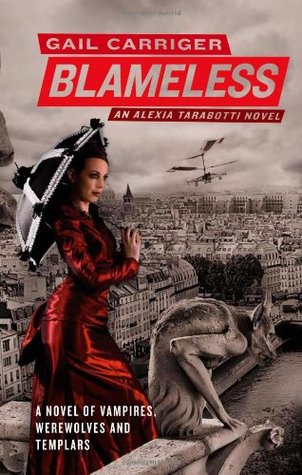
Blameless - Gail Carriger

Blameless (Parasol Protectorate, #3)
Image from Goodreads

As the third book in the generally hilarious Parasol Protectorate series I would have expected Blameless to have a lot of comedy, if it was for the cliffhanger on which Changeless ended. I’ll be the first to admit that having witnessed the loving relationship between Lord and Lady Maccon, I would never have expected, ever, for Lord Maccon to be yelling ay Alexia about her supposed betrayal.


What quickly becomes clear in Blameless is that Alexia is in fact blameless of everything Conall is accusing her of. As the reader we could, with a small leap of logic, have surmised this for ourselves long ago. But in this story it is very interesting to see how pig-headedly stubborn Conall is. I found it interesting that by the time Conall had come to his senses Alexia had already managed to get herself into, and out of, some deep and fairly personal trouble.

Something that I liked about Blameless more than the previous two books in the Parasol Protectorate series was the development of the secondary characters. It was by no means complete development, but it highlighted some traits I doubt I would have picked up on otherwise. Particularly for Professor Lyall who seemed to get more solo page time in this novel.

I loved the string of events which took place in London, from the planned swarm of Lord Akeldama to the theft of something ‘precious’ to him. Who knew Vampires swarmed? Every time I read about it I couldn’t help thinking of giant Bees.

I found the ending of the book to be beautiful and tragic in a slightly comedic fashion. The series has moved past the compulsory happy ever after. There were tears and laughter and it perfectly matched the overall ambience of the book.

At the end of book three this has turned into a series I’m not sure I’ll ever want to put down.


Rowen

Day 5